
How to Build a Public Safety Drone Budget for Payload Systems

Public Safety Drone Budget: Justifying Payload Systems
For police departments, fire departments, search-and-rescue (SAR) teams, and emergency management agencies, a drone is no longer only an aerial camera. With the right payload capability, the same aircraft may support the delivery of communications equipment, flotation aids, medical supplies, lighting, markers, or other mission-authorized items.
That added capability can strengthen a public safety drone program, but it also creates a harder internal question: how do you justify the expense to leadership, procurement, and finance teams?
A strong public safety drone budget should not begin with a product. It should begin with an operational gap. The most defensible request explains what problem exists, what capability is required to address it, what it costs to keep that capability mission-ready, and how the agency will measure results.

Why Does Payload Capability Increase the Value of a Public Safety Drone Program?
A camera-equipped drone primarily helps an incident commander see. A payload-equipped drone may also help a team act remotely, within applicable laws, policies, aircraft limitations, and operating procedures.
In a SAR mission, for example, a drone may locate a stranded person before a ground team can safely reach them. A compatible release system may allow responders to deliver an approved lightweight item such as a radio, flotation aid, or emergency supply while the rescue continues.
Drone Sky Hook explores these applications in its guide to SAR drone payload systems and its overview of drone accessories for emergency frontline missions.
For police, fire, SAR, and emergency response teams, this changes the budget conversation. The request is no longer simply for another accessory. It is for a defined operational capability.
That distinction matters because budget holders can evaluate a capability against a documented mission need, current limitation, deployment scenario, and measurable outcome.
Start the Budget Request With the Mission, Not the Equipment
The strongest public safety drone budget follows a simple sequence:

Suppose a drone team can locate a person cut off by floodwater but cannot deliver a communication device or flotation aid. The request should not begin with:
“We want to purchase a payload release system.”
Instead, document the limitation: the aircraft provides aerial awareness, but the team currently lacks a controlled method for delivering an approved lightweight item before rescuers can make physical contact.
From there, the agency can define the capability, identify compatible equipment, develop procedures, calculate total cost, and establish performance measures.
This mission-first approach also makes drone payload procurement easier to defend because procurement officers can compare products against documented operational requirements rather than marketing claims or feature lists.
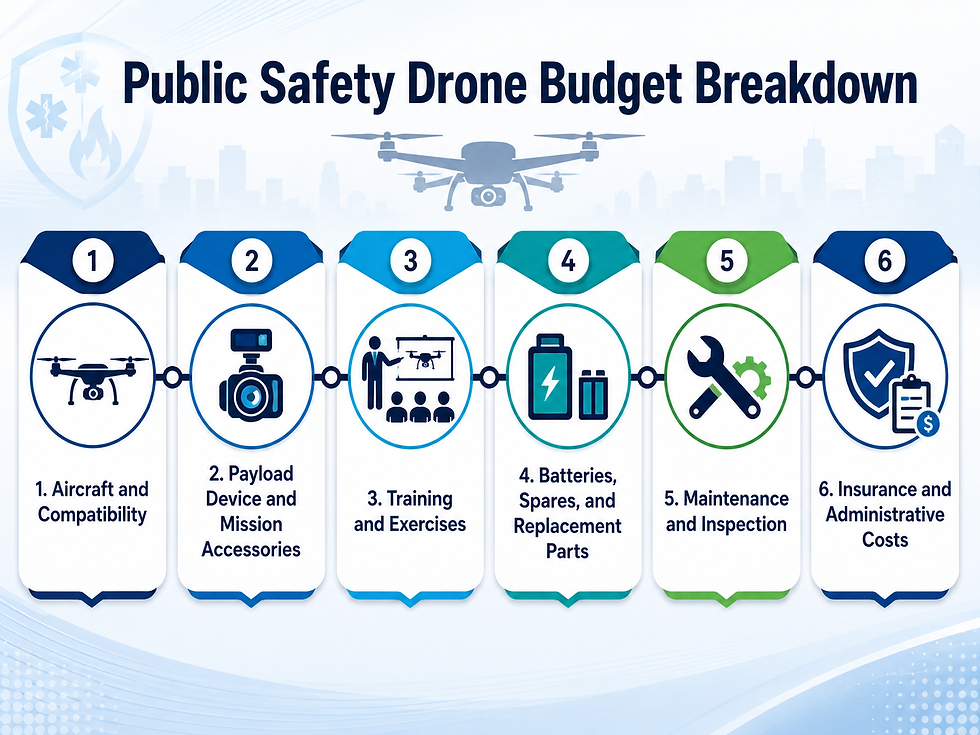
What Should Be Included in a Public Safety Drone Budget?
A complete budget should cover the full cost of making the capability safe, repeatable, and ready to deploy.
1. Aircraft and Compatibility
If the agency already owns suitable aircraft, confirm compatibility with the exact drone model and configuration. If another aircraft is required, include the aircraft itself and necessary batteries, controllers, cases, software, and supporting equipment.
2. Payload Device and Mission Accessories
Include the release mechanism, searchlight, mount, container, cord, or other mission-specific components.
When estimating drone payload system cost, do not evaluate the headline price alone. Additional hardware, modification requirements, replacement items, or integration needs can materially change the true cost.
3. Training and Exercises
Budget for operator familiarization, payload procedures, scenario-based exercises, recurrent training, and documentation.
Hardware that crews have never practiced with is not an operationally ready capability.
4. Batteries, Spares, and Replacement Parts
Public safety operations should not depend on one battery or a single critical component. Determine the redundancy required to achieve the agency's desired level of readiness.
5. Maintenance and Inspection
Include routine inspections, replacement of wear items, repairs, configuration management where applicable, and periodic functional testing.
6. Insurance and Administrative Costs
Depending on the agency, an emergency response drone budget may also need to cover insurance, registration, legal review, policy development, recordkeeping, or procurement administration.
Purchase Price Is Not the Same as Operational Readiness Cost
One of the easiest budgeting mistakes is treating purchase price as total cost.
A more useful calculation is:
Purchase + Integration + Training + Testing + Maintenance + Spares + Replacement Planning = Operational Readiness Cost
This is the figure leadership should evaluate.
The same principle applies to a SAR drone equipment budget. If a release system is purchased but the team has no approved payload list, trained operators, field-testing process, or replacement equipment, the agency owns hardware, not a dependable rescue capability.
That is why drone payload system cost should be assessed alongside reliability, integration, safety, payload capacity, installation, compatibility, and long-term usability.
Agencies evaluating these factors can also review Drone Sky Hook's guide on choosing a payload drop system for enterprise drones.
How Can Public Safety Teams Justify the Expense to Leadership?
Police, fire, SAR, and emergency management investments should not always be forced into a conventional commercial ROI model. Their value often lies in additional capability, readiness, response options, and risk management.
A stronger justification considers five areas:
● Mission coverage: What incidents can the agency support more effectively?
● Response capability: Can equipment reach a location that is difficult, slow, or risky to access conventionally?
● Responder exposure: Does the technology provide another operational option before personnel enter a hazardous environment?
● Existing asset utilization: Does the payload expand what an aircraft already owned by the agency can accomplish?
● Readiness: Can trained personnel deploy the capability consistently under approved procedures?
For finance teams, these questions translate technology into operational value and help separate a genuine requirement from a “nice-to-have” accessory.
How Do You Build a Defensible Drone Payload Procurement Request?
A well-structured drone payload procurement request should answer eight questions:
1. What operational problem exists?
2. How is that problem handled today?
3. What capability gap remains?
4. What payload capability is required?
5. Which equipment meets that requirement?
6. What is the full lifecycle cost?
7. What training, SOP, and compliance requirements apply?
8. How will success be measured?
This framework is especially valuable when several functions contribute to a public safety drone program. Operations defines the mission, the UAS team validates compatibility, procurement evaluates vendors, legal or risk teams review governance, and finance examines lifecycle cost.
For agencies developing procedures alongside procurement, Drone Sky Hook's Payload Drone SOP for Law Enforcement Agencies provides additional guidance on payload planning and operational controls.
What Evidence Should Support the Budget Request?
Use agency-specific evidence wherever possible. A strong request may include:
● relevant incident volume from the previous 12–36 months;
● after-action reports identifying access, delivery, lighting, or communication gaps;
● current aircraft inventory and utilization;
● realistic mission scenarios;
● equipment compatibility and payload limits;
● training requirements;
● expected equipment life and replacement cycle;
● alternative solutions considered;
● proposed SOPs and approval authority; and
● post-deployment KPIs.
This makes the request specific to the agency rather than dependent on generic claims about drone technology.
There is also a useful lesson in current federal funding guidance. The U.S. Department of Justice COPS Office's FY2026 Community Policing Development Microgrants program specifically includes unmanned aerial systems and identifies applications including search and rescue, pursuit operations, barricaded subjects, digital evidence gathering, and wellness checks.
The program also gives priority consideration to UAS proposals that include comprehensive evaluation of project success and public-safety impact. Review the COPS Office CPD Microgrants program
The principle applies even when local funds are being used: decide how success will be measured before purchasing the equipment.
What Metrics Can Support Next Year's Budget?
A public safety drone budget becomes easier to defend in future cycles when the agency measures performance after deployment.
Useful indicators can include:
● number of payload-capable missions;
● successful deployment rate;
● operational availability;
● average setup or deployment time;
● number of trained operators;
● equipment downtime and maintenance events;
● number of mission types supported; and
● lessons identified during exercises and real incidents.
These metrics should not encourage unnecessary drone deployment. Their purpose is to show whether the capability remains available, trained, appropriately used, and capable of delivering the value described in the original budget request.
Account for Regulation, Policy, and Funding Restrictions
Budget approval does not create operational authority.
The FAA states that drones operated by public-safety agencies must comply with applicable federal aviation requirements. Its current Public Safety Toolkit provides resources for agencies operating under applicable Part 107 or public-aircraft Part 91 pathways. FAA Public Safety Toolkit
Payload missions may also introduce considerations involving aircraft performance, operating limits, release procedures, privacy, cybersecurity, local policy, and risk management. Those requirements can affect training, documentation, equipment selection, and overall cost.
Funding requires similar care. Grant programs change and may impose specific aircraft, procurement, equipment, or accessory restrictions. For example, current federal UAS funding conditions can contain detailed requirements concerning eligible aircraft and accessories. Agencies should therefore review the applicable Notice of Funding Opportunity and award conditions rather than assuming that a drone or payload accessory qualifies for reimbursement.
How Should the Request Be Presented to Leadership?
A concise executive summary can be structured around five points:
● Operational need: State the documented capability gap.
● Proposed capability: Explain what the payload system enables the agency to do.
● Total readiness cost: Include acquisition, training, spares, maintenance, and replacement planning.
● Governance: Identify the SOP, training, regulatory, and approval framework.
● Measurement: Define the KPIs leadership will receive after deployment.
This approach turns an emergency response drone budget from an equipment wish list into a defensible capability proposal.
Budget for the Capability, Not Just the Hardware
The purpose of a public safety drone budget is not to prove that every agency needs a payload system. It is to determine whether a documented mission requirement exists and, when it does, fund the complete capability responsibly.
For police, fire, SAR, and emergency management teams, the strongest case connects mission need, compatible equipment, full lifecycle cost, training, governance, and measurable outcomes.
At the equipment-selection stage, agencies should compare systems based on reliability, compatibility, controlled deployment, installation, safety, and long-term usability, not price alone.
Drone Sky Hook provides mission-focused release, drop, and lighting solutions for compatible drone platforms, giving public-safety teams equipment options they can evaluate against their own operational requirements, procurement standards, and approved missions.
FAQ
How much should a public safety agency budget for a drone payload system?
There is no universal figure. Drone payload system cost depends on aircraft compatibility, payload hardware, accessories, batteries, training, testing, spares, maintenance, insurance, and lifecycle requirements. Agencies should budget for the complete mission-ready capability rather than the payload device alone.
What should be included in a public safety drone budget?
A public safety drone budget should include aircraft or compatibility costs, payload hardware, accessories, batteries, training, exercises, maintenance, spares, administrative expenses where applicable, and replacement planning. SOP development and compliance requirements should also be considered.
How do you justify a drone payload system to agency leadership?
Start with a documented operational gap. Explain the missions affected, current limitation, required capability, total readiness cost, governance requirements, and measurable outcomes. Lead with the mission requirement rather than product features.
Should training and maintenance be included in drone payload procurement?
Yes. Training, exercises, inspections, maintenance, replacement parts, and recurrent testing are part of operational readiness. Excluding them can make the initial drone payload procurement budget appear lower while leaving the agency with a capability it cannot deploy reliably.
How can SAR teams measure the value of payload equipment?
A SAR drone equipment budget can be evaluated using readiness and mission metrics such as operational availability, successful payload deployments, setup time, trained-operator coverage, equipment downtime, completed exercises, and the number of supported mission types.


.png)
Comments