
Why Drone Sky Hook Makes the Best Drone Accessories
- Drone Sky Hook
- Nov 28, 2025
- 5 min read

Why “Best Drone Accessories” Means Responsible, Transparent Engineering
In today’s rapidly expanding drone-accessory market, the phrase “Best drone accessories” gets tossed around liberally. But for serious drone operators, whether law enforcement, first responders, SAR teams, surveying farmland, doing precision agriculture, seeding fields, or delivering carefully calibrated payloads, accessory quality, transparency, and compliance are not optional. Among these, Drone Sky Hook stands out not because of flashy wireless gimmicks, but because it rejects them altogether in favor of a design built for safety, reliability, and regulatory compliance.

In this blog, we explore how Drone Sky Hook’s philosophy and engineering discipline, no covert electronics, full regulatory compliance, and patent-backed design, sharply contrast with the risks posed by many cheap, unbranded payload devices that flood the market.
The Hidden Danger of Cheap, Unbranded Drone Payload Devices
In recent years, drone adoption across public safety, agriculture, logistics, infrastructure inspection, and cinematography has exploded. That has given rise to a parallel boom in low-cost, unbranded payload devices, many originating from parts of the global supply chain with little transparency or oversight. On the surface, these devices may seem like a bargain, but they often come with serious hidden costs.
Risks Often Hidden from Users
Hidden wireless modules and undocumented functionality: Many cheap devices embed Bluetooth, Wi-Fi, or other wireless modules, sometimes without clearly declaring them. That means unintentional data transmission, unexpected telemetry, and potential for misuse or data leaks.
Lack of compliance testing or certification: Unbranded electronics may never have passed regulatory testing (e.g. for electromagnetic interference, wireless emissions, or safety), increasing risk of failure or interference.
Supply-chain opacity, counterfeit or sub-standard components: The flood of counterfeit electronic components is a well-known global problem, with estimates of billions of dollars in bogus ICs sold annually.
Security and privacy vulnerabilities: For drones and payload systems, that might mean unencrypted transmissions, exposure of location data, or even remote takeover. For example, academic research on the dominant commercial drone maker DJI (often used as a baseline comparison) found that its DroneID transmissions could be intercepted with low-cost radio hardware, demonstrating how apparently “standard” devices can expose location data.
Regulatory and legal risk: Increasingly, governments and regulatory bodies are screening devices and supply chains for security threats. The risk is especially acute for unbranded devices whose procurement history, vendor structure, or electronics provenance may be unknown or opaque.
In sectors like public safety, agriculture, logistics, or industrial drone operations, where drones may fly over sensitive lands, private property, or critical infrastructure, using such devices can represent a liability: from data leaks, regulatory non-compliance, to outright failure mid-flight.
Drone Sky Hook - Built Transparent, Engineered for Safety
Against this backdrop, Drone Sky Hook’s design and business philosophy offer a stark and deliberate contrast, prioritizing transparency, safety, and compliance, above all making the systems the best drone accessories for many drones.


No Covert Electronics - No Bluetooth, No Wi-Fi, No Data Transmission
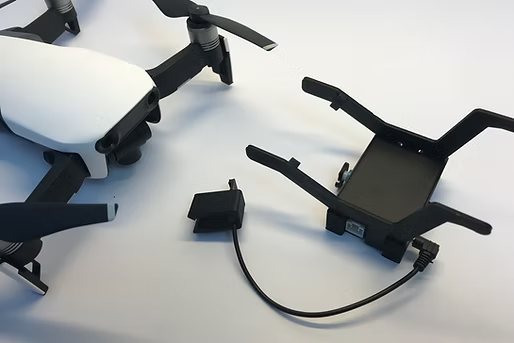
Drone Sky Hook devices contain no wireless modules, no hidden transmitters, no data logging or telemetry that could leak data. There is simply no capability for data collection or data transmission. What little internal sensing there applies strictly to flight-safety: the sensors check only the drone’s lights status and yaw (rotation) to detect a valid command from the pilot. This design ensures that the accessory cannot become a surveillance device, data-exfiltration tool, or introduce unanticipated security or privacy risks which further categorize them as the best drone accessories.
In contrast to cheap “payload hooks” with hidden electronics, this transparency means:
No risk of unauthorized data transmission.
No unexpected power draw or signal interference.
Compliance with safety and communications regulations.
For operators focused on real-world tasks, this means predictable performance.

Regulatory Compliance Matters
Beyond design philosophy, Drone Sky Hook is built to comply with stringent regulatory frameworks. In particular:
The devices are compliant with NDAA Section 889 (U.S. National Defense Authorization Act), which prohibits certain telecommunications and surveillance equipment from being used (or supplied to) U.S. federal agencies if sourced from banned entities.
The devices are also compliant with requirements from Federal Communications Commission (FCC), meaning they do not use any wireless modules, and do not emit any radio signals.
By explicitly avoiding any covered telecommunications equipment or wireless modules, Drone Sky Hook stays well clear of the kinds of technologies targeted by FCC bans and Section 889’s supply-chain restrictions.
This isn’t just about ticking regulatory boxes to qualify as the best drone accessories’ provider, it’s about engineering reliability and supply-chain integrity from the ground up.
Comparing the Risks: Unbranded vs. Drone Sky Hook’s Best Drone Accessories
Here’s a direct side-by-side comparison to highlight why choosing the right payload accessory matters:
Risk / Concern | Cheap/Unbranded Payload Devices | Drone Sky Hook |
Hidden wireless / data transmission | High possibility of Bluetooth/Wi-Fi modules, potential data leaks or remote access | Zero - no wireless, no telemetry, no data collection |
Compliance & certification | None; components may be counterfeit or non-certified | Designed to be NDAA Section 889 and FCC compliant |
Supply-chain transparency | Opaque - unknown vendors/components, potential for counterfeit ICs | Transparent vendor list, declared design, documented testing |
Security & privacy risk | Data leak, remote takeover or telemetry interception possible (as seen in drones) | No risk - no communication capability, minimal internal sensing only |
Regulatory & legal exposure | High - may violate import/telecommunications laws or pose national security concerns | Operates within regulatory frameworks, avoiding banned-tech pitfalls |
Why “Best Drone Accessories” Means Responsible, Transparent Engineering, Not Low-Cost Gambles
When hobbyists or budget-conscious buyers browse for drone accessories, it’s tempting to pick the cheapest payload hook that “seems to work.” But the true cost of such a gamble can be much higher, not just in terms of reliability, but security, compliance, and long-term liability.
As a professional user, team, or agency, whether in public safety, agriculture, resource mapping, drone-based payload delivery, or any other mission-critical use case, you deserve accessories that are engineered responsibly, with supply-chain transparency, compliance, and security as foundational design requirements. That’s what “best drone accessories” should mean.

Drone Sky Hook’s minimalist, transparent, well-engineered design, devoid of hidden wireless modules, fully compliant with relevant regulations, and built with predictable, safe operation in mind, represents precisely that standard.
Why Agencies, Governments and Professionals Are Raising the Bar?
It’s not just about good practice, across the world, regulators and security agencies are increasingly scrutinizing drone and telecom supply chains. For instance:
Laws like NDAA Section 889 and regulatory moves by the FCC are reshaping how governments and enterprises procure equipment, prioritizing supply-chain hygiene, vendor transparency, and strict bans on certain foreign-linked telecom equipment.
In such an environment, unbranded or opaque accessories carry not just performance risk, but legal and reputational risk too. For mission-critical projects, these risks are non-trivial.
Using compliant, transparent, engineered accessories like Drone Sky Hook helps safeguard not just operational reliability, but long-term compliance, traceability, and risk mitigation.
When Drone Accessory Quality Is More Than Just Price
To wrap up: the “best drone accessories” are certainly not the cheapest. In fact, in many cases, the cheapest option hides the greatest risk, hidden electronics, supply-chain opacity, security vulnerabilities, or regulatory non-compliance.
Drone Sky Hook offers a compelling alternative: a no-compromise approach rooted in transparency, safety, and compliance. By rejecting covert electronics, adhering to rigorous standards (NDAA Section 889, FCC rules), and employing well-engineered, minimalistic sensing for only the functions needed, Drone Sky Hook prioritizes reliability, trust, and mission success over gimmicks and shortcuts.


.png)
Comments